For parents of a child with a disability, the Registered Disability Savings Plan is an invaluable tool for protecting their dependent’d long-term financial needs. Yet, one its most powerful features may be its ability to inherit the retirement savings of a parent or grandparent after they pass away. The CRA allows a deceased parent’s or grandparent’s Registered Retirement Savings Plan (RRSP) or a Registered Retirement Income Fund (RRIF), or Registered Pension Plan (RPP) proceeds to be transferred tax-deferred into the RDSP of a financially dependent child or grandchild.
Normally, when the owner of an RRSP or RRIF passes away, the government treats the entire account as if it were sold on the date of death resulting in a large tax bill for the estate. By rolling these funds into an RDSP, the immediate tax bill can be avoided. The funds can be moved into an RDSP at their full value, and taxes are only paid when the beneficiary eventually makes a withdrawal.
There is a caveat. An RDSP has a lifetime $200,000 personal contribution limit, and any rollovers from registered account count against that limit. Further, if the deceased RRSP/RRIF account has more than the personal lifetime limit of the RDSP, the excess money is treated as income received by the deceased parent/grandparent in their year of death. So, the account could potentially have a large tax bill before the beneficiary receives the remaining money. Secondly, because the remaining money is not in a registered tax-sheltered account, excess money will count against the personal asset limits of the beneficiary with respect to provincial disability benefits. For example, a large lump sum of cash could immediately disqualify the Ontario Disability Support Program (ODSP) client from their support payments if they exceed the $40,000 asset limit for singles, or $50,000 for couples. Lastly, unlike the money inside an RDSP, any interest or dividends earned on this excess cash will now be taxable every year.
How does a parent or grandparent plan the rollover into a child’s RDSP?
This is a complex issue that calls for careful estate planning. The two primary options are either to name the RDSP beneficiary using the banks RRSP/RRIF beneficiary forms, or to write precise instructions into the will.
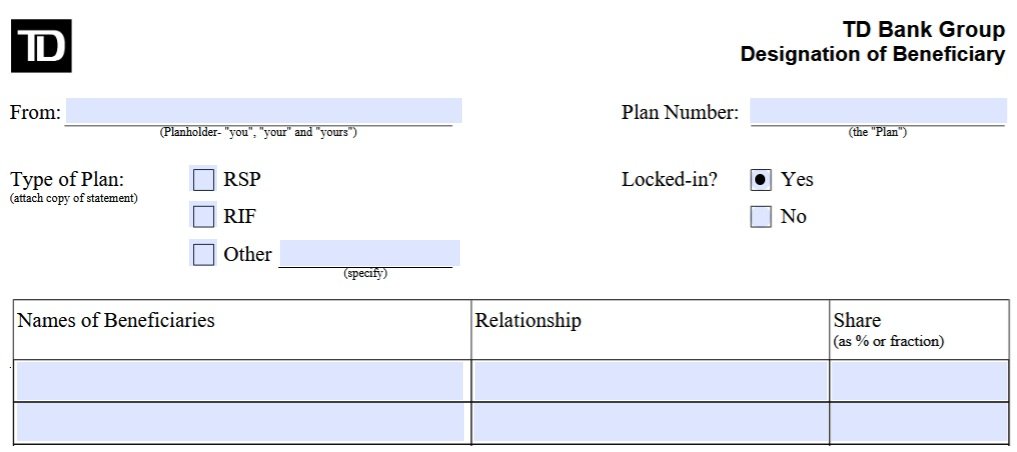
An account holder can name their child or grandchild as the direct beneficiary on their RRSP/RRIF forms at the bank. The biggest advantage of this strategy is that the money bypasses probate, meaning the money is transferred much quicker, is immune to estate administration tax, and allows for income tax deferral provided there is appropriate room in the beneficiaries RDSP. The negative is that most RRSP/RRIF beneficiary designation forms require the account holder to name beneficiaries using only share % percentages of the total account value rather than exact dollar amounts. This can create complications if the intention was to roll over the inheritance into an RDSP if the account value fluctuates over time, meaning the money to be left to the beneficiary can be much higher or lower than originally intended. And because RDSPs are subject to a $200,000 lifetime contribution limit, only the portion of the RRSP/RRIF proceeds that fits within the beneficiary’s remaining RDSP contribution room can be transferred on a tax-deferred basis. If the percentage based amount does exceed the available RDSP contribution limit, the excess cannot be rolled over and must be paid out and taxed under the normal RRSP/RRIF death benefit rules. This can create unexpected tax consequences for the beneficiary and the estate executor as both parties are jointly and severally liable for paying tax on an RRSP. So, if the bank pays the child the excess money directly and the estate cannot afford the year end tax bill, the Canada Revenue Agency (CRA) may assess and collect that tax from the beneficiary.
Why is form CRA RC4625 so important?
The rollover does not happen automatically when a beneficiary is named on a bank form, rather, the rollover is initiated by the executor during estate settlement. Upon notification of death, the financial institution will automatically freeze the deceased’s RRSP/RRIF account. To convert what would normally be a fully taxable estate payout into a tax deferred transfer, form RC4625 Rollover to a Registered Disability Savings Plan must be submitted to to the bank. The form acts as a joint election and must be signed by both the estate executor and the RDSP holder. It officially instructs the financial institution to transfer the designated funds directly into the RDSP and generates the necessary tax documentation to deduct the income on the deceased’s final tax return. If the executor fails to file this form properly alongside the final tax return, the entire account balance will be treated as fully taxable income to the deceased in the year of death.
What about specifying precise instructions in the will?
An account holder can designate the Estate as the RRSP/RRIF beneficiary and use their will to provide precise instructions. This allows the executor to calculate and roll over the exact dollar amount needed to maximize the child’s remaining $200,000 RDSP lifetime limit. While the portion being deposited into the RDSP is completely tax-deferred, any overage remaining above the limit will be taxable unless the will includes secondary instructions to move excess funds into a qualifying lifetime annuity. Unfortunately, this RDSP rollover approach means the funds will be subject to probate fees in certain provinces, and the transfer process will take much longer as the will must be validated by the courts. For families with substantial assets, utilizing a will to provide specific instructions is often the superior strategy as it allows for mathematical accuracy that standard bank forms simply cannot provide. While this option may involve higher upfront costs due to the need for specialized professionals (lawyers or estate planners), safeguarding the beneficiary’s inheritance along with the peace of mind that their financial future is secure justifies the higher price tag for many families.
What is the deadline to roll over an RRSP/RRIF into an RDSP?
The rollover into the RDSP must be completed by December 31 of the year following the year of death. So for example, if the parent passes in June 20, 2026, the deadline is December 31, 2027.
Can the excess of a rollover from a RRSP/RRIF be protected?
Estate planners generally use a Henson Trust as a safety net for the overflow of an RRSP/RRIF. A will can specify that the first $200,000 is rolled over to the beneficiary’s RDSP, and any remaining funds are moved into a Henson Trust. Because money inside a Henson trust is an exempt asset, the beneficiary would continue to qualify for provincial government supports.
Can the RRSP/RRIF from a deceased parent or grandparent be rolled over into the RDSP of a child or grandchild? What if the beneficiary of the RDSP is 60 years of age or older?
Under CRA guidelines, both personal contributions and rollovers from a RRSP/RRIF of a deceased parent or grandparent are permitted until December 31 of the calendar year in which the beneficiary turns 59. This means that rollovers are not allowed if the beneficiary is 60 years of age or older. The $200,000 lifetime limit still applies, and any money withdrawn from the RDSP does not restore or reset the lifetime allowance.
How is financial dependence determined?
In order to qualify for a rollover from a deceased parent or grandparents RRSP/RRIF, the beneficiary must have been financially dependent on the parent or grandparent for support due to their disability. The CRA automatically presumes financial dependence due to an impairment if the beneficiary’s net income for the previous tax year is below the Basic Personal Amount (BPA) plus the Disability Amount (DA), which is 16,452 (assuming net income is below $181,440)+$10,341=$26,793 as of 2026. If the child or grandchild resides elsewhere such as a group home, or earned more than in the income threshold, they can still qualify by establishing that they relied on the parent to pay for supplementary living expenses, such as specialized medical or healthcare costs.