If in a financially advantageous position, making very large deposits into an Registered Disability Savings Plan (RDSP) as early as possible would be most beneficial to maximizing the power of compound interest. Check out the RDSP Contribution Strategy Comparison for ideas of how to best strategize contributions for families with great wealth. However, most won’t have upwards of $200,000 to deposit into the account on day one.
RDSPs and the “Catch-Up” Strategy
Many Canadians who open an RDSP are unaware of the catch-up rule (or carry-forward provision) that allows recipients to retroactively claim up to 10 years of grants (maximum $10,500 per year) and bonds (maximum $11,000 per year) for all years that the beneficiary was eligible for the DTC. So even if a beneficiary was eligible for the DTC but delayed opening an RDSP and/or making personal contributions, they haven’t necessarily lost their government benefits. Unused grant and bond entitlements are automatically carried forward, allowing for backdated claims once the plan is opened. Standard RDSP rules still apply, that is the beneficiary is eligible to receive grants and bonds until December 31 of the year they turn 49 years of age, lifetime limits for grants & bonds are $70,000 and $20,000 respectively, and there is a $200,000 lifetime personal contribution limit.
Annual grant ceiling of $10,500 per calendar year
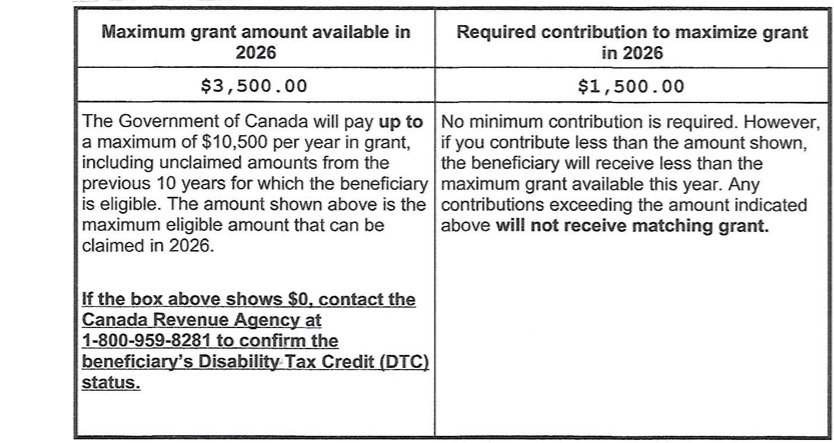
This means that for eligible account holders to maximize grant money, they should deposit at least $3,500 into their RDSP account, thus maximizing their annual carry forward grant of up to $10,500. Again, these government grants are income tested, meaning they are dependent on family or personal income.
Example – Consider a Beneficiary with 7 years of catch-up years available (current year included). They want to maximize all available grants as quickly as possible.
If a beneficiary has 7 years of unused grant room, their total 3 to 1 matching room is $3,500 ($500 x 7 years). To receive the maximum $10,500 grant in a single year, they would follow this math:
Year 1 contribution – Deposit $3,500 (the government matches the first $500 of all 7 years at a 300% rate). This would result in receiving $10,500 in grants which is the maximum allowed in one year.
Year 2 contribution – Deposit $5,000. The first $500 (the new current year) is matched at 300% = $1,500. Next, because the 300% matching room from previous years is used up, the government moves to 200% matching room. Since they have 8 years of “catch-up” room (7 years carry forward plus the current year), they have a total of $8,000 in available 200% matching room ($1,000 x 8 years). The remaining $4,500 deposit triggers a 200% match on that amount ($4,500 x 200% = $9,000), and results in them receiving $10,500 in grants which is again the maximum allowable grant for one year.
Year 3 contribution – Deposit $5,000. Once again, the first $500 gets the current year’s 300% match, generating $1,500 in grants. The remaining $4,500 deposit triggers a 200% match against the last of the carry forward room ($4,500 × 200% = $9,000). This results in a final maximized catch up grant of $10,500.
With all carry forward space fully exhausted at the end of Year 3, the beneficiary will only need to deposit $1,500 per year to receive the annual government grant of $3,500 going forward.
Check out the RDSP Grant Maximizer Calculator that helps figure out a contribution strategy to catch up on grants as quickly as possible
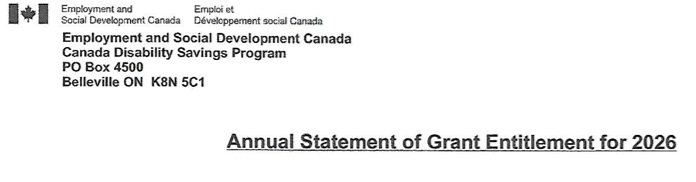
Note – Don’t worry about the math too much, every year the government will send an Annual Statement of Grant Entitlement similar to the one below. It will notify RDSP account holders exactly how much to deposit to receive the maximum annual grant.
When are grants and bonds paid into the account?
Government grants are typically matched at the end of the following month. For example, if a contribution is made January 1st 2026, the grant is usually deposited into the RDSP around February 28 or March 1st.